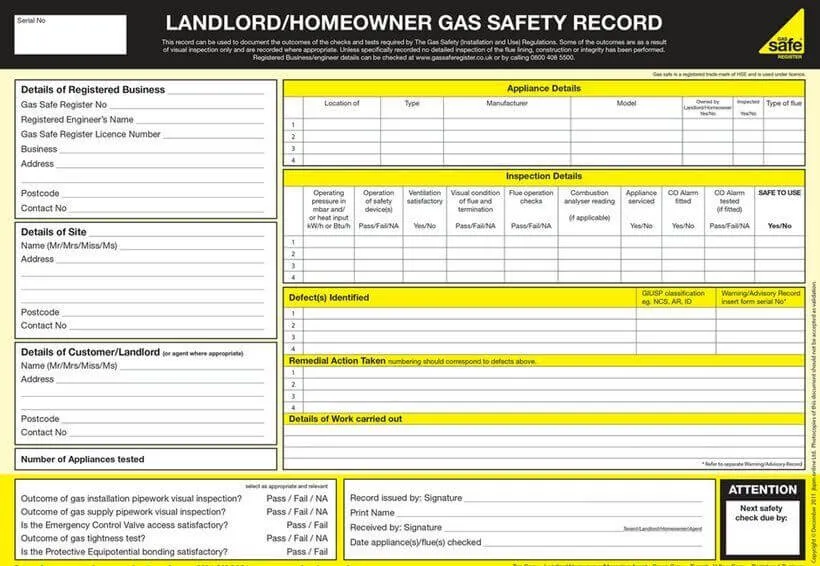
There is no single certificate the law requires every business to hold, the way landlords must hold a CP12. But the duty to keep gas appliances safe is real, and an annual inspection record is how most businesses show they have met it.
A business in the UK is not required by law to hold a specific gas safety certificate in the way a residential landlord must hold a Landlord Gas Safety Record, but it is legally required to keep its gas appliances, pipework and flues in a safe condition. In practice, the way most businesses show they have met that duty is an annual inspection by a Gas Safe registered engineer qualified for commercial work, recorded on a commercial gas safety record. Insurers, landlords and local authority inspectors will usually ask to see that record, so treating it as optional is rarely a good idea.
What the Law Actually Requires of a Business
The Gas Safety (Installation and Use) Regulations 1998 require employers and self-employed people to make sure any gas appliance, pipework or flue at a place of work under their control is maintained in a safe condition. The regulations do not name a form or a fixed interval for this duty.
That is the key difference from residential letting. A landlord of a home must have an annual check and give tenants a copy of the record. A business owner must keep the installation safe, but the law leaves it to them to decide how. The wider Health and Safety at Work etc. Act 1974 sits behind this, together with the duty to assess risks to employees and the public. An annual inspection by a suitably qualified engineer, with a written record, is the accepted way of showing the maintenance duty has been taken seriously. If something goes wrong and there is no record, the business has little to show that it did anything at all.
Which Businesses This Applies To
Any business premises with gas appliances is covered: shops, offices, restaurants, cafes, pubs, workshops, salons, surgeries, schools and places of worship. The duty sits with whoever controls the gas installation.
Typical installations include wall-hung or floor-standing boilers heating an office or shop, gas water heaters, warm air heaters in workshops, and commercial catering equipment. The size of the business makes no difference. A small cafe with a single gas range has the same basic duty as a large office building, though the inspection itself will be very different in scope. Our article on how often commercial gas appliances should be serviced covers the maintenance intervals for each type of premises.
Commercial Kitchens Need Closer Attention
Gas catering equipment is checked against a separate catering record, commonly called a CP42, and HSE guidance for catering premises expects regular inspection and maintenance. For most kitchens that means at least once a year.
A catering inspection looks at more than the appliances. The engineer checks the gas supply and isolation, the ventilation and extraction, and any interlock that shuts off the gas if the extraction stops. Each cooking appliance is checked for safe operation and its safety devices tested. Busy kitchens often benefit from more frequent servicing, because grease and heavy use wear burners and controls quickly. The engineer must hold the commercial catering categories on their Gas Safe registration, which are different from those for commercial boilers.
Renting Commercial Premises: Who Is Responsible?
Responsibility follows control of the gas installation, which is usually set out in the lease. In many commercial leases the tenant is responsible for appliances inside the unit, while the landlord keeps the shared plant and common parts.
Read the lease's repairing and maintenance clauses. If you are a tenant running a restaurant, the catering equipment and the kitchen's gas installation are almost always yours to maintain. If the landlord supplies central heating to several units from one plant room, the landlord normally maintains that plant. Where the lease is unclear, ask for the position in writing before an inspection is due, not after an insurer asks for the record.
Mixed-Use Buildings: The Flat Above the Shop
If any part of the building is let as a home, the residential rules apply to that part, even if the rest is commercial. The flat above a shop needs an annual landlord gas safety check and a record given to the tenant.
This catches out owners of mixed-use buildings in London, where shops with flats above are common. The shop or restaurant is covered by the commercial maintenance duty, and the flat is covered by the landlord rules, which are stricter on timing and paperwork. Where one boiler serves both parts, the engineer needs to be qualified for the work involved and the records should make clear what each part covers. The residential record must go to the tenant within 28 days of the check.
Why a Written Record Matters Even Where the Law Does Not Name One
A commercial gas safety record is the evidence that you met your maintenance duty. Insurers often make an annual inspection a condition of cover, and many commercial leases require one.
A record also gives you something to act on. It lists the appliances checked, any defects found and how serious they are, and the advice given. An appliance classed as immediately dangerous will be disconnected with your permission, and one classed as at risk will usually be turned off until it is repaired. Keeping each year's record, together with service reports for the boilers, gives you a clear history if an environmental health officer, insurer or buyer ever asks. Our page on the commercial gas safety certificate explains what the inspection covers.
When a Gas Safety Record Is Not What You Need
A safety record confirms the installation was safe on the day. It is not a service, and it will not keep a commercial boiler running efficiently or protect a warranty.
If your premises is heated by a commercial boiler, it needs regular servicing in line with the manufacturer's instructions as well as the safety inspection. Many businesses book both at the same time so the dates line up and the premises is disturbed only once. Our commercial boiler servicing page covers what a service visit includes. If you are not sure which you need, send us a list of your gas appliances and tell us what the premises is used for. We will tell you what inspection and servicing fit, and whether any part of the building falls under the residential rules.
Frequently asked questions
Is a gas safety certificate a legal requirement for a business?
No specific certificate is named in law for businesses, unlike the Landlord Gas Safety Record for rented homes. But businesses must keep gas appliances, pipework and flues maintained in a safe condition, and an annual inspection record is the usual way to show that duty has been met.
How often should a business get a gas safety inspection?
Once a year is the accepted standard for most premises, and insurers and leases often require it. Commercial kitchens with heavy use may need servicing more often. Any appliance showing signs of a fault should be checked straight away rather than at the next annual date.
Can any Gas Safe engineer inspect commercial gas appliances?
No. The engineer must be registered for the commercial categories that match the work, and commercial catering is a separate category from commercial heating. The back of the engineer's Gas Safe ID card lists what they are qualified to do.