What Certificates Does a Landlord Need in London?
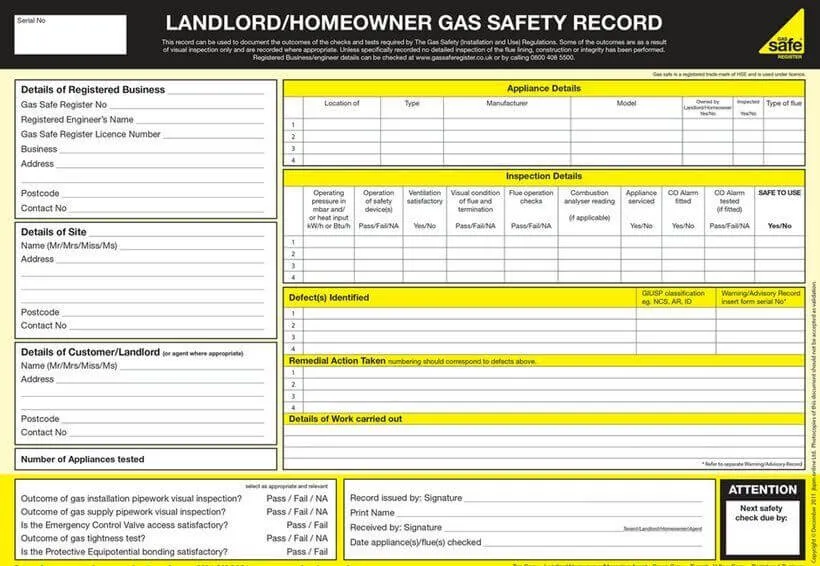
A London landlord needs three core certificates: a Gas Safety Record every year if there is any gas appliance, an Electrical Installation Condition Report at least every five years, and a valid Energy Performance Certificate. Here is how each one works and what else sits alongside them.
A landlord letting a home in London needs three core certificates: a Gas Safety Record (CP12) renewed every year if the property has any gas appliance, an Electrical Installation Condition Report (EICR) at least every five years, and a valid Energy Performance Certificate (EPC). Alongside those, you need working smoke and carbon monoxide alarms, protected deposit paperwork and, in some cases, a property licence from the council. This guide covers private lets in England. Rules in Wales and Scotland differ.
Gas Safety Record (CP12): Every Year
If the property has any gas appliance, you need a Gas Safety Record renewed every 12 months. It is carried out by a Gas Safe registered engineer and covers every gas appliance, pipework and flue you provide.
The record is often still called a CP12, after the old form number. The engineer checks the boiler and any gas hob, cooker, fire or water heater for safe operation and ventilation, and records the result for each one. You must give existing tenants a copy within 28 days of the check, give new tenants a copy before they move in, and keep each record for at least two years.
A new check can be done up to two months before the current record expires while keeping the original renewal date, which makes it easier to avoid a gap. Our page on the Landlord Gas Safety Certificate explains what the inspection involves, and our article on how often a gas safety certificate needs renewing covers the timing in detail.
Electrical Installation Condition Report (EICR): At Least Every Five Years
Private landlords in England must have the fixed electrical installation inspected and tested at least every five years. The result is an Electrical Installation Condition Report, produced by a qualified and competent electrician.
The report covers wiring, sockets, light fittings, the consumer unit and other fixed parts of the installation. It does not cover appliances you plug in. A copy must go to existing tenants within 28 days of the inspection and to new tenants before they move in, and you must give it to the local council within seven days if they ask for it. If the report identifies work that is required, that work has to be completed within 28 days or sooner if the report says so. The report may recommend a shorter interval than five years, in which case the shorter interval applies.
Energy Performance Certificate (EPC): Valid for Ten Years
You need a valid EPC before you market a property to let, and it must be given to prospective tenants. An EPC is valid for ten years.
The certificate rates the property's energy efficiency from A to G. Under the minimum energy efficiency standard, a privately rented home in England generally needs a rating of E or better, unless a valid exemption has been registered. If your EPC is close to expiry, or the rating is borderline, it is worth dealing with before a tenancy starts rather than during one. A well-maintained, serviced boiler will not change your rating on its own, but it is part of keeping the property efficient in practice.
Smoke and Carbon Monoxide Alarms
There is no certificate for alarms, but the rules are legal requirements. You must have a smoke alarm on every storey used as living accommodation, and a carbon monoxide alarm in any room used as living accommodation that has a fixed combustion appliance, other than a gas cooker.
That means a room with a gas boiler, gas fire or wood burner needs a carbon monoxide alarm. You must check the alarms are working on the first day of each new tenancy, and repair or replace any alarm a tenant reports as faulty. Keeping a dated note of the first-day check is sensible, because it is the only evidence it happened.
Deposit, How to Rent and Other Paperwork
Several other documents are not certificates but still need to be in place from the start of a tenancy. Missing them can cause problems later, including if you ever need to regain possession of the property.
- Deposit protection. A deposit taken for an assured shorthold tenancy must be protected in a government-approved scheme, and the tenant given the prescribed information within 30 days.
- How to Rent guide. The current version of the government's guide should be given to tenants at the start of the tenancy.
- Right to Rent checks. Landlords in England must check that tenants have the right to rent before the tenancy starts, and keep a record of the check.
- Legionella risk assessment. Landlords have a duty to assess and control the risk from legionella in the water system. No certificate is required, but a written note of the assessment is good practice.
HMO and Property Licences
Some London properties need a licence from the council as well as the certificates above. Large houses in multiple occupation need a mandatory HMO licence, and many London boroughs run additional or selective licensing schemes that cover other rented homes.
Licensing rules are set borough by borough and change over time, so check your council's current scheme before letting. A licence application will usually ask for your current gas safety record and EICR, so having those in date makes the process simpler. Our guide to gas safety compliance for HMO landlords covers the gas side of letting to several households.
Keeping Every Certificate in Date
The simplest approach is one record per property listing each certificate, its issue date and its renewal date. Gas is the one that comes round every year, so it is the one most likely to lapse.
An annual boiler service is not a certificate and is not a separate legal requirement for landlords, but many landlords book it on the same visit as the gas safety check. It keeps the boiler's service history unbroken for the warranty, and it means one appointment and one period of tenant access instead of two.
Frequently asked questions
Is an annual boiler service a legal requirement for landlords?
No. The legal requirement is the annual gas safety check and record (CP12). A boiler service is maintenance, recommended by manufacturers and usually required to keep a warranty valid. Many landlords combine the two in one visit.
Do I need a gas safety certificate if the property is all-electric?
No. The Gas Safety Record only applies where there is a gas appliance, gas pipework or flue that you provide. An all-electric property still needs an EICR, an EPC and working smoke alarms.
Do I need a new EICR or EPC for every new tenant?
No. An EICR remains valid for up to five years, or the shorter interval stated in the report, and an EPC for ten years, regardless of tenancy changes. You do need to give each new tenant a copy before they move in. The gas safety record is the only one renewed every year.