Boiler Flue in a Ceiling Void: Do You Need Inspection Hatches?
If your boiler flue runs through a ceiling void or boxing, a Gas Safe registered engineer has to be able to inspect it. Without inspection hatches, the boiler is classed as At Risk at a service or gas safety check. Here is what the rule means and how to sort it before your next visit.
If your boiler's flue runs through a ceiling void or boxing, a Gas Safe registered engineer must be able to inspect it, and that normally means inspection hatches. Since the start of 2013, a concealed flue that cannot be inspected is classed as "At Risk" at a service or gas safety check, and the engineer will ask to turn the boiler off until the flue can be seen. This mostly affects flats built or converted in the last twenty years, where the boiler sits in a kitchen cupboard on an internal wall and the flue travels several metres across the ceiling to an outside wall. If that describes your home, here is what the rule means, what the engineer looks for and what to do before your next visit.
Why a Hidden Flue Is a Safety Problem
The flue carries combustion gases, including carbon monoxide, from the boiler to the outside. If a joint in a hidden section has come apart or was never pushed fully home, those gases can leak into the ceiling void and from there into the rooms below or the flat next door.
Gas Safe Register investigated a number of cases where flues in voids had been badly assembled, left unsupported or damaged by later building work, and nobody could see the problem because the flue was sealed behind plasterboard. Its guidance to engineers, known as Technical Bulletin 008, was the response. The point is not that concealed flues are forbidden. It is that a flue has to be checked along its whole length, and a flue nobody can see cannot be checked.
What the Engineer Checks on a Flue in a Void
With hatches in place, the engineer looks at the whole run of the flue, not just where it leaves the boiler and where it ends outside. They are confirming that it is continuous, correctly assembled and properly supported.
- Joints. Every joint is fully engaged and secured with the clips or screws the manufacturer specifies.
- Support. Brackets are in place at the intervals the manufacturer requires, so the flue cannot sag or pull apart.
- Fall. On a condensing boiler, a horizontal flue should fall slightly back towards the boiler so condensate drains back rather than collecting in the flue.
- Condition. No damage, dents, holes or signs of leakage, and nothing from later building work drilled or screwed into it.
- Length and components. The route and number of bends are within the manufacturer's limits for that boiler model.
These checks sit alongside the combustion analysis and safety device tests that make up a normal visit. Our annual boiler service page lists everything a service covers.
What Counts as a Suitable Inspection Hatch
Hatches should be at least 300mm by 300mm, and positioned so that no joint in the concealed flue is more than 1.5 metres from the edge of the nearest hatch. That lets the engineer see and reach every joint along the run.
On a short run, one hatch may be enough. A long flue across a hallway ceiling can need two or three. Where the flue passes through a ceiling that separates your flat from another, or forms part of a fire-protected escape route, the hatch may need to keep the fire resistance of that ceiling, so ask the building manager or freeholder before a builder cuts anything. Cutting and fitting a hatch is building work rather than gas work, but nobody other than a Gas Safe registered engineer should disturb, separate or refit any part of the flue itself.
What Happens at a Service or Gas Safety Check Without Hatches
If the engineer cannot inspect a concealed flue, they will record the installation as At Risk and, with your permission, turn the boiler off. They cannot simply note it and leave it running as if it had been checked.
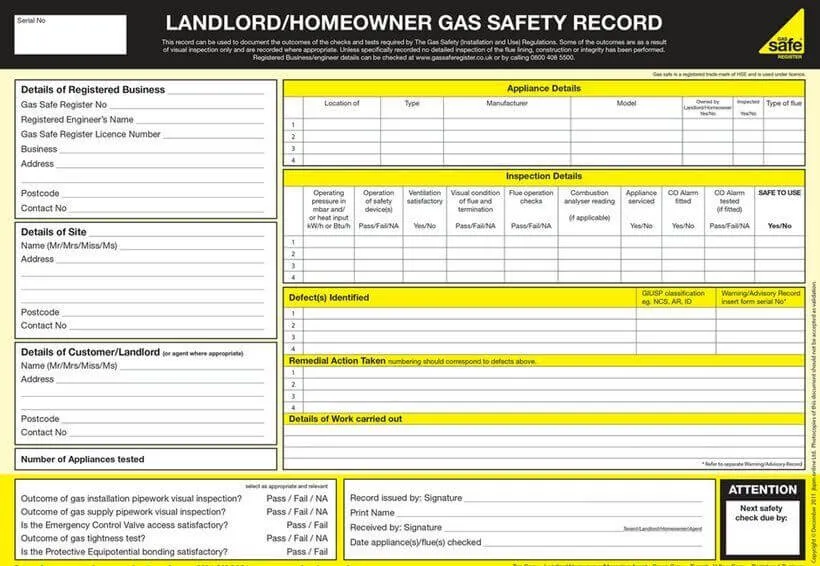
The engineer follows the Gas Industry Unsafe Situations Procedure. For an At Risk classification, they explain the risk, turn the appliance off with the permission of the person responsible, attach a warning notice and record it on the paperwork. If you refuse permission, they note that too. On a landlord's gas safety check, the record will show the boiler as not safe to use, which means it is not a clean record you can hand to a tenant. Our guide to the common reasons a boiler fails its gas safety check covers the other issues that can be recorded the same way.
If the engineer can see enough of the flue through existing access, such as a removable ceiling tile or a boxing panel, and every joint can be inspected, there is no issue. The rule is about whether it can be inspected, not about how it is concealed.
What Landlords Need to Do
Book the hatches before the gas safety check, not after it. A landlord must have every gas appliance they provide checked every 12 months, and a boiler turned off because its flue cannot be inspected leaves a tenant without heating or hot water and the landlord without a usable record.
If you are not sure whether your flat has a concealed flue, look at where the boiler is. A boiler on an internal wall, with no flue terminal on the wall directly behind it, almost always has a flue running through a ceiling or boxing. Tell the engineer when you book, so they can confirm whether hatches are already fitted and whether they are in the right places. In a block, check your lease or ask the managing agent who is responsible for the ceiling, as some leases treat ceilings as the landlord's part of the building. Our landlord gas safety certificate page explains what the annual check covers and how the record is issued.
What Homeowners Need to Know
Owner-occupiers are not legally required to have a gas safety record, but the same rule applies at a boiler service. An engineer who cannot inspect the flue will treat the boiler as At Risk whether you rent or own.
If you are buying a flat, ask the seller whether the boiler flue runs through a void and whether hatches have been fitted. It is a common finding on newer London flats, and it is better to know before completion than on the first service. Where hatches truly cannot be fitted, for example because the ceiling is part of a structure you are not allowed to cut, the remaining options are rerouting the flue or moving the boiler, both of which are larger jobs that need a proper survey.
Getting It Sorted Before the Next Visit
The simplest route is to have the flue assessed, get the hatches fitted in the right places, and have the flue inspected through them on the same visit as your service or gas safety check. That avoids a boiler being turned off in the middle of winter.
- Check whether your boiler is on an internal wall and where the flue leaves the building.
- Look for existing hatches in the ceiling or boxing along that route.
- If you are in a block, confirm who is responsible for the ceiling and whether hatches must be fire-rated.
- Tell the engineer about the concealed flue when you book, so enough time is allowed.
- Keep a note of where the hatches are with your boiler paperwork, so the next engineer finds them quickly.
If you smell fumes, see soot marks on a ceiling near the flue route, or your carbon monoxide alarm sounds, do not wait for a routine visit: turn the boiler off, open windows, leave the property and call the National Gas Emergency Service on 0800 111 999. For a planned visit, tell us where your boiler and flue are and we will confirm what the visit needs before it is booked.
Frequently asked questions
Is it illegal to have a boiler flue in a ceiling void?
No. A concealed flue is allowed, but it must be possible to inspect it along its whole length. Without suitable inspection hatches, a Gas Safe registered engineer will classify the installation as At Risk at a service or gas safety check and ask to turn it off.
What size should a flue inspection hatch be?
At least 300mm by 300mm, positioned so that no joint in the concealed flue is more than 1.5 metres from the edge of the nearest hatch. A long flue run may need more than one hatch.
Can a landlord get a gas safety certificate without flue inspection hatches?
Not a clean one. If the flue cannot be inspected, the engineer records the boiler as At Risk on the gas safety record and turns it off with permission, so it cannot be treated as safe to use until hatches are fitted and the flue is checked.