Who Services a Communal Boiler in a Block of Flats?
Usually the freeholder or the managing agent acting for them, not the leaseholders or tenants. What a communal boiler service covers, how it fits the landlord gas safety rules and how to check it is being done.
In most London blocks, a communal boiler is serviced by whoever controls the plant room: the freeholder, a residents' management company or right-to-manage company, or the managing agent acting for them. Leaseholders and tenants do not book it themselves. The cost is normally recovered through the service charge, and the boiler should be serviced at least once a year by a Gas Safe registered engineer who holds the right qualifications for that size of plant.
Who Is Responsible for Servicing a Communal Boiler?
The party that owns or controls the boiler is responsible for keeping it maintained, and in a block of flats that is almost always the building owner or the company that manages the building for them. The lease usually spells this out, together with how the cost is shared between flats.
A communal boiler sits in a shared plant room and heats several flats at once. No single leaseholder owns it, so none of them can arrange its service. The usual set-up:
- Freeholder. Owns the building and, under most leases, has the repairing and maintenance obligation for shared plant.
- Managing agent. Books the engineer, keeps the records and recovers the cost through the service charge. As with individual lettings, appointing an agent hands over the tasks, not the legal duty. Our guide to managing agent vs landlord gas safety responsibility explains where that line falls.
- Residents' management or right-to-manage company. Where leaseholders have taken over management, the company takes on the freeholder's maintenance role for the plant, usually through its own agent.
What a Communal Boiler Service Covers
A communal boiler service follows the manufacturer's instructions for each boiler and adds checks on the plant room around it. It takes longer than a domestic service because there is more equipment serving more people.
What is checked depends on the installation, but a typical annual visit covers:
- Each boiler or module. Burner, heat exchanger and condensate route cleaned and inspected as the manufacturer requires, with a combustion analysis to confirm the boiler is burning safely.
- Flues. Every flue route checked for condition, support and correct termination. Plant rooms often have long or shared flue runs that need more attention than a single domestic flue.
- Ventilation. Plant room air vents checked for size and blockages. A plant room that has been used as storage is a common problem.
- Safety controls. Gas isolation valves, any gas detection or automatic shut-off system, and any interlock that stops the boilers running if ventilation fails.
- Pressurisation and expansion. The pressurisation unit and expansion vessels that keep a sealed system at the right pressure.
- Pumps and controls. Circulating pumps and sequence controls, so the boilers share the load.
Many managing agents also book interim visits in the heating season. That is a maintenance choice, not a legal requirement. Our commercial boiler servicing guide covers how larger plant is scheduled and recorded.
Does the Landlord's Gas Safety Record Cover the Communal Boiler?
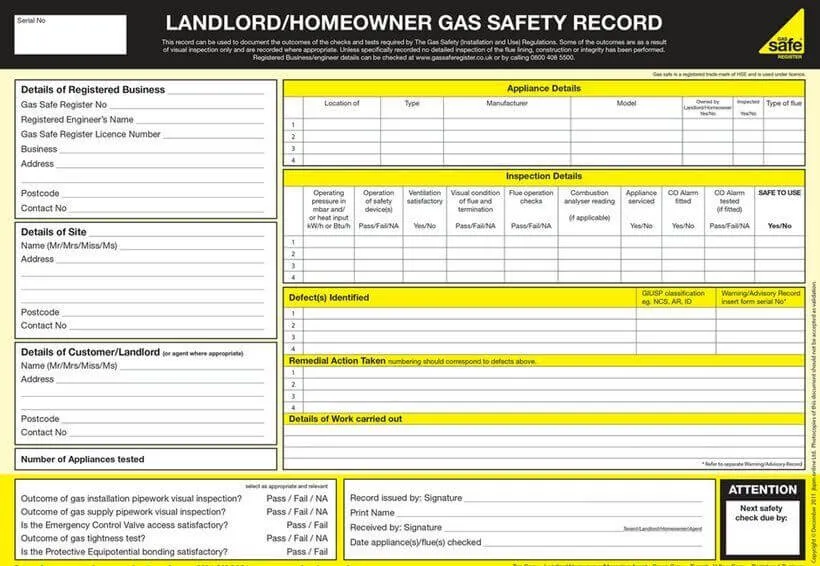
If a flat is let and a communal gas boiler heats it, that boiler is part of the landlord's annual gas safety duty, so it must be safety checked every year and a record kept. What changes is who arranges the check, and how tenants see the record.
The Gas Safety (Installation and Use) Regulations 1998 require a landlord to maintain gas appliances and flues that serve a let home, and to have them safety checked within every 12 months. That includes appliances outside the flat itself, such as a boiler in a plant room, where the landlord owns them or controls them. In practice the building's owner or agent arranges the check on the communal plant, and the landlord of each flat needs a copy of that record for their own files.
Two practical points follow from this:
- Where the only gas appliance serving the flat is the communal boiler, the regulations allow the record to be displayed in a prominent place in the building instead of being handed to each tenant. The displayed copy must say that tenants are entitled to their own copy on request.
- Gas appliances inside the flat still need their own check. A gas hob or gas fire in a flat heated by a communal boiler is the flat landlord's responsibility, and it needs an annual safety check and a landlord gas safety certificate in the usual way.
An owner-occupying leaseholder has no legal duty to hold a gas safety record for their own home, but still pays for the communal service and has good reason to see that it happens.
What It Means for Leaseholders and Tenants
If you live in a flat heated by a communal boiler, you do not book its service and you should not be charged separately for it outside the service charge. What you can do is ask to see evidence that it has been done.
For leaseholders, the service charge is where the cost of servicing, repairs and maintenance contracts appears. Long-term maintenance contracts and major works on the plant can trigger formal consultation with leaseholders under section 20 of the Landlord and Tenant Act 1985, so a new multi-year boiler contract should not simply appear on your bill without notice. If you want to see what was done, ask the managing agent for the latest service report and gas safety record for the plant.
For tenants, the landlord of your flat is responsible for the gas appliances that heat it, even though the boiler is in a room you cannot enter. If you have not seen a gas safety record covering the communal boiler, ask your landlord or letting agent for a copy.
Who Is Qualified to Service Plant-Room Boilers
The engineer must be on the Gas Safe Register and qualified for the type of appliance in front of them. Large communal boilers are often non-domestic appliances, so a domestic boiler qualification alone may not be enough.
Each engineer's Gas Safe card lists the work they are qualified for, split into domestic and non-domestic categories. Plant-room boilers above domestic sizes, cascades and pressure-jet burners fall into the non-domestic ones, so check the card against the plant you have.
Plant rooms are also built to different standards from domestic installations, so an engineer who works on this type of plant regularly will know what the room itself should look like, not just the boiler.
How to Tell Whether the Service Is Actually Being Done
Look for a dated written record for each visit, signed by a named engineer, listing each boiler checked, the combustion readings and any defects found. A line on a service charge budget that says boiler maintenance is not evidence of a service.
A properly run communal boiler usually has:
- A service report for each visit, with the date, the engineer's name and Gas Safe number, and results for every boiler.
- A current gas safety record for the plant, dated within the last 12 months, if any flat it serves is let.
- A log recording faults and call-outs between services.
- A clear list of defects with what was done about each one. An appliance classed as unsafe should have been isolated until repaired, and that should be written down.
If the records are missing or out of date, raise it with the managing agent in writing. If you manage the building and cannot find the last service record, book a full service and safety check rather than waiting for the heating season. You can contact us with the number of boilers, their make and where the plant room is, and we will tell you what the visit involves before anything is booked.
When the Communal Boiler Is Not the Right Question
Not every block with shared heating has a communal gas boiler, so check what you have before asking for a boiler service.
- Flats with their own boilers. Many converted houses and older blocks have a separate boiler in each flat. Each boiler belongs to that flat, and the leaseholder or flat landlord arranges its service, not the freeholder.
- Heat networks. Some newer developments take heat from an energy centre or district network, with a heat interface unit in each flat instead of a boiler. The energy centre is maintained by the heat network operator, and the unit in your flat is usually maintained under your heat supply agreement. A gas boiler service is the wrong answer there.
Frequently asked questions
Who pays for servicing a communal boiler?
Normally the leaseholders, through the service charge. The freeholder or managing agent books and pays the engineer, then recovers the cost from each flat in the proportions set by the lease. Tenants renting a flat do not pay for it directly unless their tenancy agreement says otherwise.
Does a communal boiler need a gas safety certificate?
If any flat it heats is let, yes. A landlord's annual gas safety duty covers appliances that serve a let home, including a boiler in a shared plant room that the landlord owns or controls. The check must be done within every 12 months by a Gas Safe registered engineer qualified for that type of appliance.
Can a leaseholder arrange a service on the communal boiler themselves?
No. The plant belongs to the building and is controlled by the freeholder or management company, so a leaseholder cannot instruct work on it. If you think the service is overdue, ask the managing agent in writing for the latest service report and gas safety record.